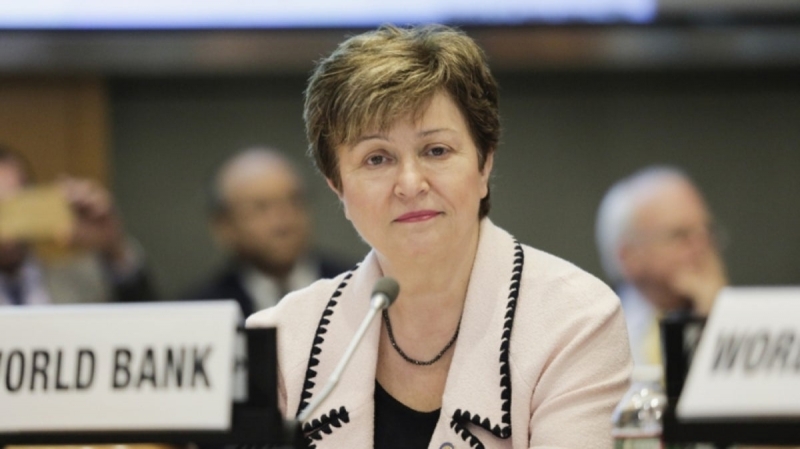

Here is the blog from IMF managing director Kristalina Georgieva:
I have been saying for a while that this is a ‘crisis like no other.’ It is:
- More complex, with interlinked shocks to our health and our economies that have brought our way of life to an-almost complete stop;
- More uncertain, as we are learning only gradually how to treat the novel virus, make containment most effective, and restart our economies; and
- Truly global. Pandemics don’t respect borders, neither do the economic shocks they cause.
The outlook is dire. We expect global economic activity to decline on a scale we have not seen since the Great Depression.
This year 170 countries will see income per capita go down – only months ago we were projecting 160 economies to register positive per capita income growth.
Actions taken
Exceptional times call for exceptional action. In many ways, there has been a ‘response like no other’ from the IMF’s membership.
Governments all over the world have taken unprecedented action to fight the pandemic—to save lives, to protect their societies and economies. Fiscal measures so far have amounted to about $8 trillion and central banks have undertaken massive (in some cases, unlimited) liquidity injections.
For our part, the IMF has $1 trillion lending capacity – 4 times more than at the outset of the Global Financial Crisis—at the service of its 189 member countries. Recognizing the characteristics of this crisis—global and fast-moving such that early action is far more valuable and impactful—we have sought to maximize our capacity to provide financial resources quickly, especially for low-income members.
In this regard, we have strengthened our arsenal and taken exceptional measures in just these two months.
These actions include:
- Doubling the IMF’s emergency, rapid-disbursing capacity to meet expected demand of about $100 billion. 103 countries have approached us for emergency financing, and our Executive Board will have considered about half of these requests by the end of the month.
- Reforming our Catastrophe Containment and Relief Trust, to help 29 of our poorest and most vulnerable members—of which 23 are in Africa—through rapid debt service relief, and we are working with donors to increase our debt relief resources by $1.4 billion. Thanks to the generosity of the UK, Japan, Germany, the Netherlands, Singapore, and China, we are able to provide immediate relief to our poorest members.
- Aiming to triple our concessional funding via our Poverty Reduction and Growth Trust for the most vulnerable countries. We are seeking $17 billion in new loan resources and, in this respect, I am heartened by pledges from Japan, France, UK, Canada, and Australia promising commitments totaling $11.7 billion, taking us to about 70 percent of the resources needed towards this goal.
- Supporting a suspension of official bilateral debt repayments for the poorest countries through end 2020—a ground-breaking accord among G20 countries. This is worth about $12 billion to nations most in need. And calling for private sector creditors to participate on comparable terms—which could add a further $8 billion of relief.
- Establishing a new short-term liquidity line that can help countries strengthen economic stability and confidence.
This is the package of actions that the International Monetary and Financial Committee endorsed last week at our virtual Spring Meetings.
It represents a powerful policy response. Above all, it enables the IMF to get immediate, ‘here and now’ support to countries and people in desperate need. Today.
Preventing a protracted recession
But there is much more to be done and now is the time to look ahead. To quote a great Canadian, Wayne Gretzky: “Skate to where the puck is going, not where it has been.”
We need to think hard about where this crisis is headed and how we can be ready to help our member countries, being mindful of both risks and opportunities. Just as we responded strongly in the initial phase of the crisis to avoid lasting scars for the global economy, we will be relentless in our efforts to avoid a painful, protracted recession.
I am particularly concerned about emerging markets and developing countries.
They have experienced the sharpest portfolio flow reversal on record, of about $100 billion. Those dependent on commodities have been further shocked by plummeting export prices. Tourism-dependent countries are experiencing a collapse of revenues, as are those relying on remittances for income support.
For emerging economies, the IMF can engage through our regular lending instruments, including those of a precautionary nature. This may require considerable resources if further market pressures arise. To prevent them from spreading, we stand ready to deploy our full lending capacity and to mobilize all layers of the global financial safety net, including whether the use of SDRs could be more helpful.
For our poorest members, we need much more concessional financing. With the peak of the outbreak still ahead, many economies will require significant fiscal outlays to tackle the health crisis and minimize bankruptcies and job losses, while facing mounting external financing needs.
But more lending may not always be the best solution for every country. The crisis is adding to high debt burdens and many could find themselves on an unsustainable path.
We therefore need to contemplate new approaches, working closely with other international institutions, as well as the private sector, to help countries steer through this crisis and emerge more resilient.
And the IMF, like our member countries, may need to venture even further outside our comfort zone to consider whether exceptional measures might be needed in this exceptional crisis.
Preparing for recovery
To help lay the foundations for a strong recovery, our policy advice will need to adapt to evolving realities. We need to have a better understanding of the specific challenges, risks and tradeoffs facing every country as they gradually restart their economies.
Key questions include how long to maintain the extraordinary stimulus and unconventional policy measures, and how to unwind them; dealing with high unemployment and ‘lower-for-longer’ interest rates; preserving financial stability; and, where needed, facilitating sectoral adjustment and private sector debt workouts.
We also must not forget about long-standing challenges that require a collective response, such as reigniting trade as an engine for growth; sharing the benefits of fintech and digital transformation which have demonstrated their usefulness during this crisis; and combating climate change—where stimulus to reinforce the recovery could also be guided to advance a green and climate resilient economy.
Finally, in the new post-COVID-19 world, we simply cannot take social cohesion for granted. So we must support countries’ efforts in calibrating their social policies to reduce inequality, protect vulnerable people, and promote access to opportunities for all.
This is a moment that tests our humanity. It must be met with solidarity.
There is much uncertainty about the shape of our future. But we can also embrace this crisis as an opportunity—to craft a different and better future together.
Kristalina Georgieva is the Managing Director of the IMF.