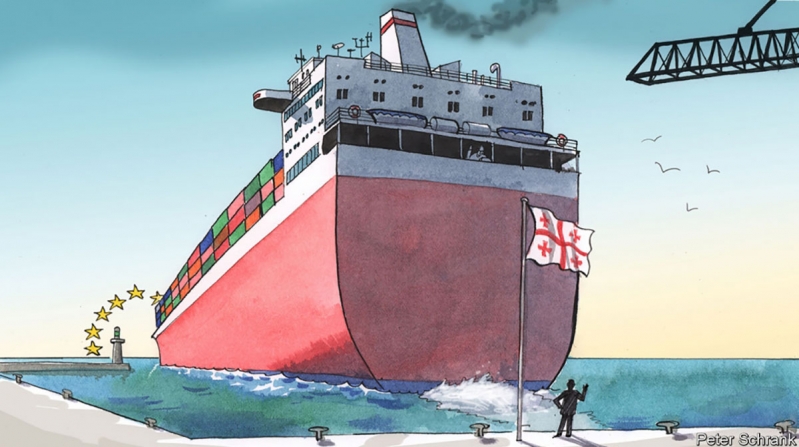
A new mega-port may force western Europeans to think differently about Georgia.

It is off-season in Anaklia. The snack stands on the Black Sea promenade are shut, the hotels are empty, palm trees rustle in the mild February breeze. Cows graze amid marshy ponds and tangerine and hazelnut orchards. But just outside this sleepy Georgian resort, a lunar landscape is emerging. Black sand has been dredged from the seabed to create an eight-metre high, 80-hectare plateau to drain water from the boggy ground into 2,500km of pipes. These are the first steps in the construction of a new deep-water container port. To stand here and look in different directions is to grasp its significance. North along the coast: Abkhazia, a Russian-backed breakaway state, then Russia, then battle-scarred Ukraine. Straight ahead: the Black Sea and, over the horizon, the eu.
Georgia is blessed and cursed by its geography, says Salome Zourabichvili, its new president. Blessed because the country is a lush intersection on the silk roads between Europe and Asia. Cursed because it is hemmed in by mighty empires with a penchant for invading: Persians, Turks and Arabs from the south, Mongols and Russians from the north. Moscow ruled Georgia for most of the 19th and 20th centuries, and invaded briefly in 2008. It still has control over Abkhazia and South Ossetia, another breakaway, and last year warned of a “terrible conflict” should Georgia try to join nato. Georgians, however, want to join not just nato but the eu too. “We consider ourselves European, perhaps even more so than the Europeans,” jokes Ms Zourabichvili.
Yet leaders in Brussels, Berlin and Paris consider Georgian membership of either club improbable for now. Though it outperforms some eu member states on crucial indicators like transparency, the country is on the “wrong” (eastern) side of the Black Sea and thus considered part of Russia’s neighbourhood. The port under construction at Anaklia proposes to change this perception by, in effect, shrinking the Black Sea and giving western Europeans other reasons to care about Georgia.
How? Currently there are three land corridors between China and Europe: a southern one, via Iran, made impractical by American sanctions; a middle one, via the Caspian Sea and then across Georgia to the Black Sea, made impractical by the lack of modern deep-sea Georgian ports; and a northern one, via Russia, on which most east-west land trade currently flows. Anaklia proposes to change that by giving the middle corridor the deep-sea port it lacks and removing the bottleneck.
The first phase of construction—two container berths and one for bulk goods like fertiliser, plus eu-funded road and rail links—is due for completion by 2021. Financed by a consortium of Georgian, European and American investors, as well as the Chinese-backed Asian Infrastructure Investment Bank, it will have an annual capacity of 1m teu, about twice that of all of Georgia’s existing ports combined (one teu is equivalent to one regular container). The long-term plan envisages expanding that to 5m teu within four decades, making Anaklia the largest port on the Black Sea. It will accommodate 10,000-teu ships, the largest that can pass through the Bosporus. Existing Georgian ports are limited to ships around one-tenth the size. Currently goods are loaded onto small vessels and taken to Istanbul, where they are transferred to larger ships from other Black Sea ports for the onward journey through the Mediterranean. Anaklia will enable such vessels to sail directly from Georgia, drastically increasing trade on the route. The consortium, Georgia’s government and European partners claim this will make the country more relevant to the West, increase interaction across the sea and (it is suggested) raise the diplomatic costs of future Russian interventions. “We know the eu is not ready to offer us membership,” says Natalie Sabanadze, Georgia’s ambassador in Brussels: “But we want to be prepared for when they are.”
There is an additional dimension. Five minutes from Anaklia, Georgian soldiers in a watchtower peer over marshy woodlands to the demarcation line with Abkhazia. Farther along the Enguri River, preposterously large Georgian and Abkhazian flags fly from opposite hilltops. In between, ethnic Georgian residents of Abkhazia walk daily across a footbridge to a cluster of taxis and shops on the Georgian-controlled side to claim their pensions, obtain medication and take their children to school. The jobs and prosperity generated by Anaklia will, Georgian authorities hope, increase the pressure on Abkhaz and Russian authorities to liberalise travel—last month they sealed the “border” for 26 days—and perhaps eventually move towards talks on power sharing.
The new silk road
Running a project of such ambition in a volatile region has not been simple. Construction at Anaklia was meant to begin in 2016, but wobbles over financing and a change of government slowed things down. Russian journalists have suggested that the port might be a covert nato naval base. And now tbc Bank, a big backer, is under investigation over allegations of money laundering (tbc denies these). Consortium insiders hint at sabotage attempts, but point out that it has now raised the $600m needed for construction and that work is under way.
If Anaklia dodges the brickbats and succeeds, it will become a symbol. “Enough with post-Soviet,” proclaims Tedo Japaridze, a former Georgian foreign minister and vice-chairman of the Anaklia consortium: “Georgia is not a post-Soviet state!” He has a point. Young Georgians have no memory of the Soviet Union and a fading one of the invasion in 2008. “The legacy of the Soviet Union is gradually leaving the region, along with the influence of Russia,” concurs Thomas de Waal of Carnegie Europe, a think-tank, pointing to both the Anaklia port project and free-trade deals with the eu and China. Europeans might, in other words, have to get used to the idea that the country is not, in fact, merely part of Russia’s neighbourhood. Blessed and cursed by its geography Georgia may be. But it does not have to be a prisoner of it.